
Why Proper Insurance Matters for Furniture Assembly
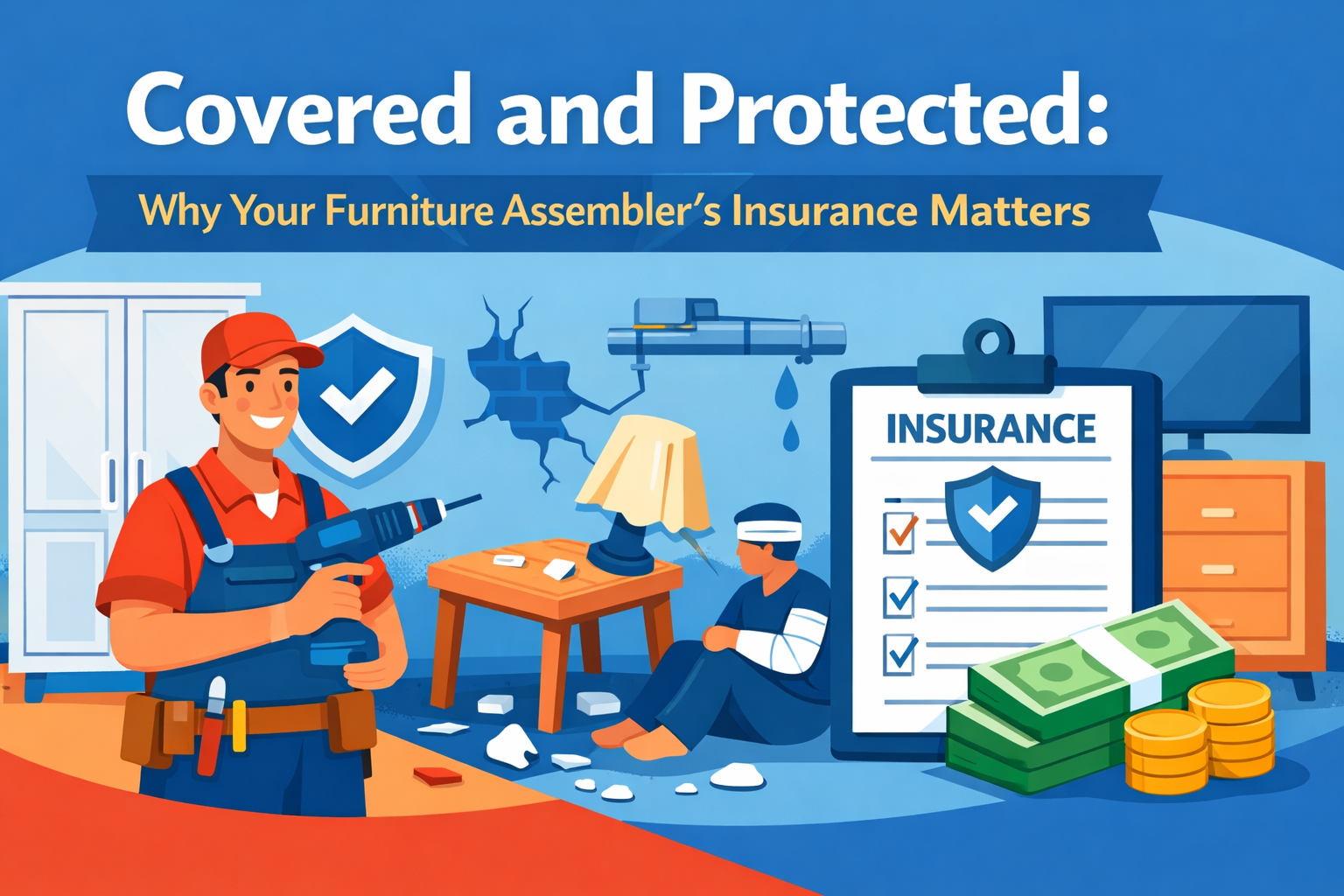
When you hire a furniture assembler, you’re not just paying for speed and convenience.
You’re trusting someone inside your home with your walls, floors, furniture, and sometimes even your building’s rules.
In a city like Toronto, where condos, tight spaces, and expensive interiors are the norm, one small mistake can turn into a serious problem.
That’s where insurance stops being a “nice extra” and becomes the difference between a quick fix and a financial headache.
What Can Actually Go Wrong During Assembly?
Most jobs go smoothly. But pretending there’s zero risk is just naive.
Here’s what realistically happens on job sites:
Scratched hardwood floors or dented drywall
Damaged furniture during assembly
Improper wall anchoring into drywall or concrete
Ladder slips or lifting injuries
Issues that show up later, like a loose mount or unstable unit
And in condos, things escalate fast. One mistake can affect neighbouring units or shared spaces.
This isn’t fear-based. It’s just reality.
Why Insurance Matters More Than You Think
If your assembler is properly insured, problems follow a process.
If they’re not, you’re gambling.
Without insurance:
You may pay out of pocket for damage
There’s no structured claims process
You’re stuck arguing over responsibility
The person may disappear after the job
With proper insurance:
There’s a clear path to resolve issues
Damage can be covered
Everything is documented and handled professionally
That’s the difference between a stressful situation and a manageable one.
What Insurance Should a Professional Assembler Have?
Here’s what actually matters from a customer perspective.
Commercial General Liability (CGL)
This is the core coverage.
It typically covers:
Property damage caused during the job
Bodily injury related to the work
Legal defence costs if something escalates
In professional environments, $2,000,000 coverage is a common standard.
Why it matters:
This is what protects your home if something goes wrong.
Commercial Auto Insurance
If a company is driving to your home for work, this matters.
In Ontario, auto insurance is mandatory for registered vehicles, with minimum liability requirements.
Why it matters:
If damage happens during arrival, parking, or unloading, this is what applies.
WSIB (Workplace Coverage in Ontario)
In Ontario, many businesses with workers must be registered with WSIB, and independent operators can opt in.
Why it matters:
If someone gets injured in your home, there’s a structured system handling it, not a personal dispute.
Professional Liability (E&O)
Less common, but relevant for more complex jobs.
This covers mistakes in planning or advice.
Why it matters:
If someone miscalculates or installs something incorrectly due to poor judgment, this can apply.
Why “Show Me Your Insurance” Is Normal
A lot of customers feel awkward asking this.
They shouldn’t.
In professional environments, it’s standard.
Government contracts require proof of insurance
Cities often require it for permits
Larger clients won’t even consider you without it
If a company hesitates to provide proof, that’s not a small red flag. That’s a deal breaker.
Real Example: How Bad It Can Get
There was a case in Ontario where a simple connection failure caused over $3,000,000 in property damage after a home was occupied.
Insurance companies got involved. Legal action followed.
Now imagine something like that happens and the person responsible has no coverage.
Good luck recovering anything.
This is exactly why insurance exists.
What To Do If Something Goes Wrong
If damage happens, don’t panic. Just handle it properly.
Stop the work if continuing could make it worse
Take photos and document everything immediately
Inform the assembler on-site
Ask for a written summary of what happened
Request insurance details if needed
Notify building management if it’s a condo
The key is documentation. Always.
The Difference Between Cheap and Professional
This is where most people mess up.
They compare prices without understanding risk.
Cheap services:
Often uninsured
No process if something goes wrong
Focus on speed over care
Professional services:
Fully insured
Structured and accountable
Designed to handle problems properly
The cheaper option only works when nothing goes wrong.
That’s not a strategy. That’s luck.
The 6IX Assembly Approach
At 6IX Assembly, this isn’t an afterthought.
Every job includes:
Fully insured service
12-month workmanship warranty
Careful, detail-focused installation
Complete packaging removal and cleanup
We treat your space like it matters, because it does.
And if something unexpected happens, it’s handled properly. No shortcuts, no disappearing acts.
Final Thoughts
Anyone can show up with tools and assemble furniture.
But not everyone is prepared to take responsibility if something goes wrong.
Insurance isn’t just protection. It’s proof that you’re dealing with a real business.
If you’re letting someone into your home, don’t just ask how fast they can do it.
Ask how they handle it when things don’t go perfectly.
That answer tells you everything.
