
The Rise of Modular FurnitureIs Assembly Getting Easier or More Complex?
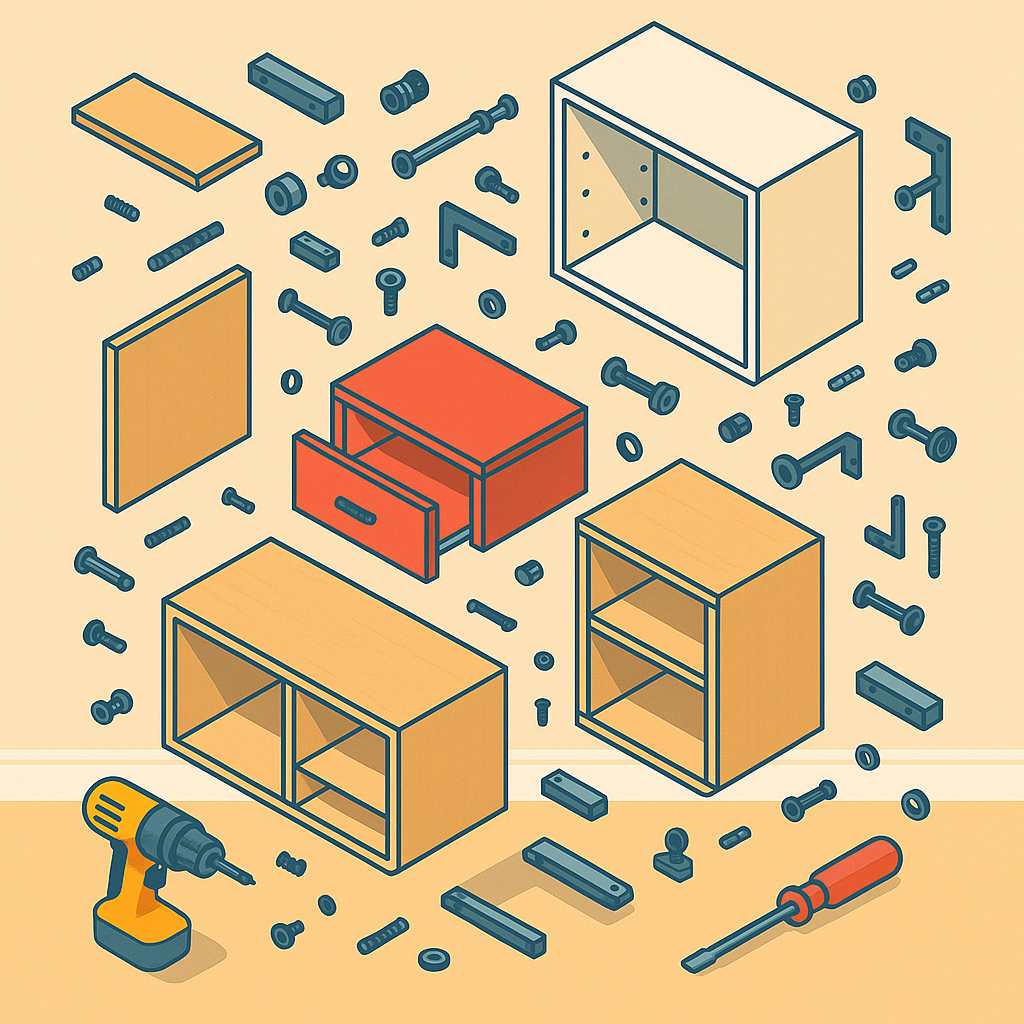
Professional modular furniture installation with precise leveling and anchoring
Modular furniture is no longer a design niche. It is now the dominant direction of the furniture industry. From IKEA and Structube to high end European brands like Poliform and USM, modular systems are everywhere. Homeowners love the flexibility. Designers love the clean lines. Retailers love the logistics.
But here is the uncomfortable truth most brands will not say out loud:
Modular furniture is easier to sell, not easier to assemble.
In many cases, it is actually more complex than traditional furniture. If you are a DIYer, a designer specifying systems, or a retailer managing post purchase support, you need to understand what is really happening behind the scenes.
What Modular Furniture Actually Means
Modular furniture is built from standardized components that can be combined in hundreds or thousands of configurations.
Common examples include:
Wardrobe systems
Wall storage systems
Entertainment units
Kitchen and pantry systems
Office workstations
Sofas with interchangeable arms and sections
Instead of one finished product, you get a system of parts that must be engineered on site.
From a supply chain perspective, this is brilliant.
From an assembly perspective, it is a controlled engineering project.
Why Modular Furniture Is Exploding Right Now
This trend did not happen by accident. It is driven by five major forces.
1. Urban Living and Smaller Spaces
Toronto condos are smaller every year. Fixed dimension furniture no longer works. Modular lets people design around tight layouts, bulkheads, and awkward walls.
2. E Commerce Logistics
Flat packed, modular products ship cheaper, faster, and with fewer damages. Retailers save millions in freight and warehousing.
3. Personalization at Scale
Customers want custom without paying full custom prices. Modular is the compromise.
4. Faster Product Cycles for Brands
Brands can release new modules instead of full collections. More SKUs. More upsells. More revenue.
5. Resale and Reconfiguration
Homeowners move more often and want furniture that can move with them.
All good for the industry. All brutal for proper assembly.
The Myth That Modular Furniture Is Easier to Assemble
This is where reality hits DIYers hard.
On paper, modular should be easier. Smaller boxes. Repetitive parts. Standardized hardware.
In practice, here is what actually happens:
More parts per square foot
More leveling requirements
More anchoring points
Stricter tolerances
Zero margin for measurement error
Traditional furniture usually has one fixed geometry. Modular systems have dozens of dependency points. One mistake at the base multiplies into massive visible errors at the end.
That is not easier. That is higher risk.
Assembly Complexity Then vs Now
Traditional Furniture
Single unit construction
Fixed dimensions
Minimal leveling
Low anchoring frequency
Cosmetic mistakes often hidden
Modular Furniture
Multi unit alignment
Tolerance stacking
Laser level accuracy required
Wall anchoring is structural
Mistakes amplify visually and structurally
If traditional furniture is carpentry, modular furniture is installation engineering.
Where Modular Assembly Usually Fails
Based on hundreds of real installations, most failures happen in five areas.
1. Measurement and Layout Errors
Designers often spec modules without accounting for:
Baseboards
Wall bows
Ceiling crowns
Electrical outlets
Vent placement
A single missed measurement can force full disassembly.
2. Incorrect Load Distribution
Many modular systems rely on shared load paths. DIY installs frequently overload single panels or brackets which leads to sagging or wall failure.
3. Improper Wall Anchoring
Drywall anchors where studs are required
Masonry screws where sleeves are required
Metal studs treated as wood studs
This is where real safety issues occur.
4. Tolerance Stacking
Every module is within manufacturing tolerance. Stack enough of them and visual misalignment becomes unavoidable without correction shims and micro adjustments.
5. Ignoring Long Term Movement
Condos settle. Houses shift. Temperature cycles expand and contract materials. Cheap installs fail months later, not on day one.
Is Any of This Getting Easier With Technology?
Only partially.
What has improved:
CNC machined panels are more accurate
Pre drilled hardware is more consistent
Digital planning tools are stronger
What has not improved:
Real world walls are still not square
Concrete is still inconsistent
Stud spacing is still unpredictable
Human error is still human
Modular systems are more precise than ever, which ironically makes field installation less forgiving than ever.
Precision demands precision.
The Retailer Reality Nobody Talks About
Retailers love modular furniture because:
Lower shipping costs
Higher average order values
Fewer returns before delivery
But after delivery, support tickets increase dramatically due to:
Missing parts
Confusing instructions
Wall condition conflicts
Anchoring limitations
Customer assembly anxiety
Retailers win on logistics. They often lose on customer satisfaction without professional installation partners.
Designers Face a Hidden Risk With Modular
Designers increasingly specify full modular systems for:
Closets
Entertainment walls
Office storage
Retail displays
But here is the professional risk:
If the system looks wrong after install, the client blames the design, not the installer.
A beautiful rendering can be destroyed by a one degree leveling error across a 10 foot run.
Designers who understand installation constraints early produce better projects and fewer disasters.
DIY Homeowners and the Real Cost Question
DIYers usually focus on money saved. They forget to calculate:
Time investment
Tool acquisition
Physical risk
Wall damage
Re order delays
Warranty complications
A modular wardrobe system that costs $4000 can turn into a $6000 project after corrections, fixes, replacements, and lost weekends.
This is not hypothetical. We fix these every week.
Is Modular Furniture Worth It?
Yes. When done properly.
No. When rushed, underplanned, or under installed.
Modular furniture is not inherently bad. It is simply unforgiving. It demands:
Proper site inspection
Accurate measurement
Correct anchoring strategy
Professional leveling
Load planning
Experience with system behavior
You cannot shortcut engineering with optimism.
Who Modular Furniture Is Best For
Ideal For
Urban homeowners planning long term layouts
Designers creating integrated spaces
Retail buyers building resale flexibility
Office builders needing future reconfiguration
High Risk For
First time DIYers
Rental units with poor wall structure
Basements with uneven slabs
Ceilings with heavy bulkheads
Anyone trying to rush installation in one evening
The Real Answer
Is Assembly Getting Easier or More Complex?
More complex. No debate.
Manufacturing is getting better. Logistics are getting cheaper. Configurations are getting infinite.
Installation is getting harder.
Modular furniture has shifted from simple assembly to structural integration. It is no longer just building furniture. It is now part interior construction.
If brands keep selling modular as easy assembly, customers will keep getting burned.
If homeowners keep treating modular like Lego, they will keep paying twice.
Final Take From the Field
Modular furniture is the future. It is not a shortcut.
It rewards planning. It punishes guessing.
When installed correctly, it is stunning, efficient, and upgradeable.
When installed poorly, it is crooked, unsafe, and expensive to fix.
The product itself is only half the system.
The other half is the quality of the assembly.
And that half is where most projects fail.
